
In 2026, AI is the phrase on everyone’s lips. Small business owners especially are keen to understand how to get their website to appear in AI searches. And the knowledge that optimising for AI is crucial for online visibility raises more questions: What about traditional SEO strategies? Is AI optimisation as well as or instead of?
AI search now shapes what users see before they ever click a website. Traditional search engine results still matter, yet AI-generated overview panels and conversational summaries increasingly sit above them. If your brand fails to appear in those AI results, your visibility shrinks long before a visitor reaches your homepage. This guide explains how to appear in AI and how to optimise for AI using structured website content. It also covers how AI overview systems draw from search engine results and how to measure AI search return on investment. You will also find a practical AI search optimisation checklist at the end – so read on.
The Difference Between AI Optimisation and Traditional SEO
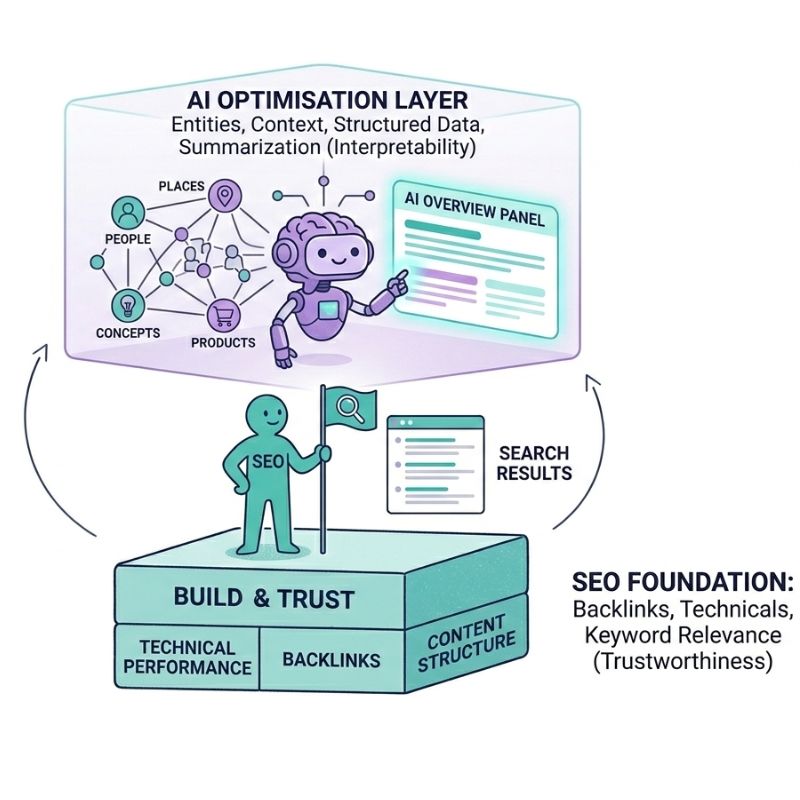
AI optimisation and traditional SEO overlap but are not identical. SEO focuses on ranking pages in search engine results for specific keywords. It relies on signals like backlinks, technical performance, content structure, and user engagement to show search engines that a page is relevant for certain queries. AI optimisation builds on that foundation but adds another layer: eligibility for AI systems to extract and summarise your content into overview panels.
AI doesn’t simply look at keywords. It evaluates entities — people, places, concepts, products—a longside context.
AI doesn’t simply look at keywords. It evaluates entities — people, places, concepts, products—a longside context. Structured data, clear definitions, and authoritative content help AI understand what your website is about. For example, a page that ranks well for “solar panel installation” may still be overlooked by AI if the content doesn’t clearly establish your business as an entity providing solar services.
SEO remains the base. AI systems pull information from content that search engines have already indexed and validated. Strong SEO increases crawlability, authority, and clarity—all of which improve AI eligibility. In other words, AI depends on SEO to know which content exists and is trustworthy, while entity clarity and structured content determine whether AI can confidently extract and display it.
Think of SEO as building a strong foundation. AI optimisation is about making that foundation readable and interpretable for machines, so your expertise gets recognised and summarised in ways users see immediately.
How to Appear in AI Search Results and AI Overview Panels
To understand how to appear in AI, it helps to grasp the basics of how AI search works. AI systems do not browse the web in the way a human does. They retrieve, compare and synthesise information from structured sources that search engines have already crawled and indexed.
When someone enters a query into a search engine, AI layers analyse the highest-confidence sources, extract relevant passages and assemble an overview. That overview often cites, paraphrases or references multiple websites. Inclusion depends on clarity, authority and structure.
AI systems summarise content they can interpret confidently. They avoid ambiguity and prioritise consistency.
Your goal is eligibility. AI systems summarise content they can interpret confidently. They avoid ambiguity and prioritise consistency. If your website answers specific questions clearly, uses logical headings and demonstrates subject authority, you increase the likelihood of appearing in AI results and overview panels.
How to Optimise Your Website for AI Search Engine Results
To optimise for AI, your website must be technically sound. AI retrieval depends on crawlability, accessibility and structured HTML. A technically unstable website is harder to crawl and retrieve information from and therefore, may reduce your eligibility.
Your pages should load quickly and avoid crawl blocks. It’s important for both AI and traditional search engines to use a clear heading hierarchy. Each page should only have one main H1 heading and subheadings should be marked as H1 or H2. It is very much worth getting to grips with Schema markup if you haven’t already. Schema markup strengthens interpretability and should be used on all relevant pages. Article schema clarifies authorship. FAQ schema structures question-based answers. LocalBusiness schema reinforces entity identity and is extremely helpful for both AI and search engines to understand your location and type of business.
Images matter too. Descriptive alt text improves accessibility and contextual signals. AI systems increasingly interpret visual content alongside text, especially when generating multimodal results.
Linking related articles clearly helps AI understand the topic. When your content forms logical clusters, it boosts your site’s authority. A well-organised website makes it easier for AI to pull content into overview results.
How Search Engine Results Feed AI Overview Visibility
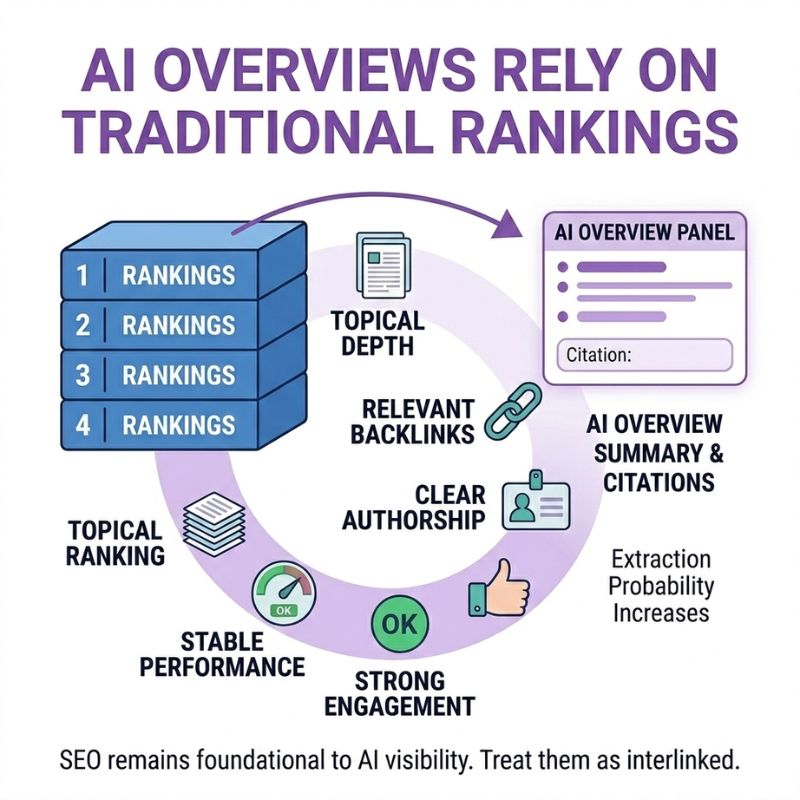
AI overviews rely heavily on traditional search engine rankings. Pages that rank consistently for relevant queries are more likely to be summarised. Authority signals still influence visibility. These signals include:
- Consistent topical depth
- Relevant backlinks
- Clear authorship
- Strong engagement metrics
- Stable technical performance
Rather than treating AI optimisation as separate from SEO, treat them as interlinked. Strong search engine results increase the probability of AI extraction. Clear extractable passages increase the likelihood of being quoted in AI overview panels. Search engine performance remains foundational to AI visibility.
Writing Website Content That AI Can Extract and Use in Results
AI systems extract passages that function independently. That means each section of your article should contain complete explanations rather than fragmented ideas.
For example, when explaining how to appear in AI, write a sentence that stands on its own. Example: “AI search systems prioritise structured, authoritative website content that clearly answers user intent and demonstrates subject expertise.”
Avoid vague introductions and abstract commentary. Precision improves extractability. Clear definitions, supported by explanation, strengthen your chances of appearing in AI overview results.
Building Topical Authority to Optimise for AI at Scale
“Topical authority” means demonstrating that your website is an authority on your particular topic, and it influences AI eligibility. Publishing isolated blog posts on unrelated subjects weakens semantic focus as AI systems struggle to categorise inconsistent content.
Building clusters of related content helps AI understand your content and what questions it answers.
Building clusters of related content helps AI understand your content and what questions it answers. Create a pillar page around a core theme such as AI search strategy. Support it with related articles covering measurement, website structure, case studies and implementation frameworks. Link these pieces logically.
Consistency across headings, metadata and body content reinforces context and therefore, is as important as it has always been for traditional SEO. Over time, search engine results reflect that authority and AI systems recognise repeated expertise patterns. Authority compounds gradually, and depth around a defined theme increases the likelihood of being referenced in AI results.
AI Search Return on Investment: Tracking Website Impact Beyond Clicks
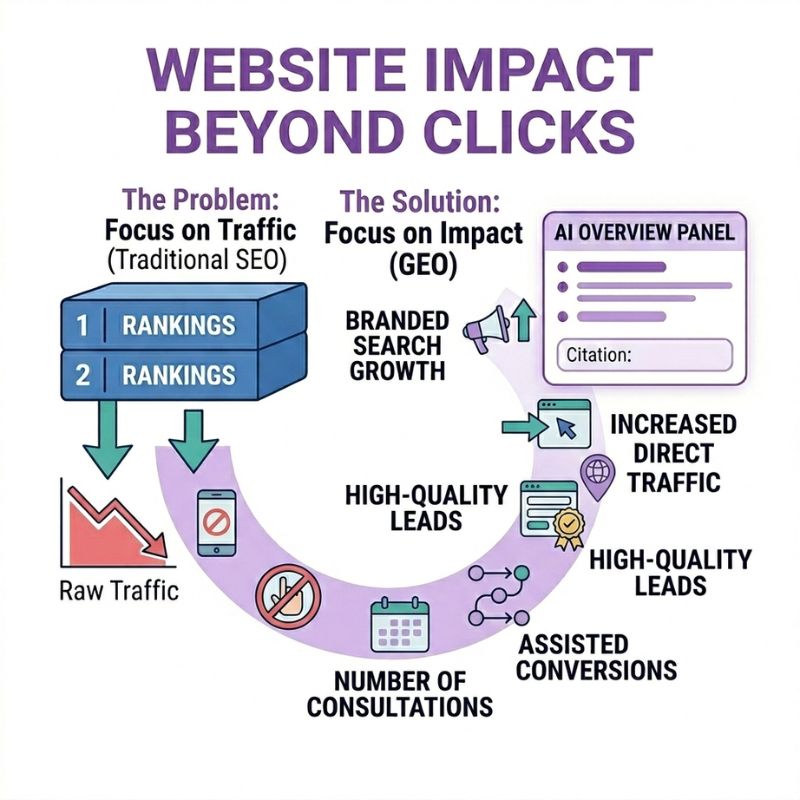
AI visibility doesn’t always show up in traffic numbers. Overview panels in search engines can reduce clicks because users see answers directly without visiting your website. Looking only at traffic gives an incomplete picture. Focus on metrics that show real impact:
- Growth in branded searches
- Increases in direct traffic
- Quality of leads generated
- Assisted conversions
- Number of consultations booked
When your brand appears in AI overviews regularly, users remember it and are more likely to return. AI search return on investment usually shows up in better revenue efficiency rather than raw traffic. Authoritative AI presence often leads to higher-quality leads and shorter sales cycles.
Case Study: How Mouthy Marketing Increased AI Search Return on Investment
Mouthy Marketing wanted to improve visibility for queries related to how to appear in AI and optimise for AI search strategy. The objective focused on authority positioning. The first step involved restructuring the website around a clear topical cluster dedicated to AI search optimisation. A pillar article covered strategic foundations. Supporting content explored AI search return on investment, technical optimisation, extractable writing techniques and measurement frameworks.
Next, structural refinement strengthened clarity. Heading hierarchy was standardised. Schema markup was implemented consistently. Internal links connected related articles. Thin pages were consolidated to improve authority signals.
Each article included extractable definitions designed for AI overview inclusion. Author bios were expanded to demonstrate expertise in SEO and strategic marketing. Testimonials and case examples reinforced credibility. Within four months, branded search queries increased by 38%. Consultation enquiries rose by 24%. Several AI tools began referencing Mouthy Marketing content inside overview responses. Traffic growth remained steady rather than explosive. Crucially, AI search return on investment demonstrated measurable business impact. The strategy prioritised structure, authority and clarity across the website.
The Role of AI Content Generators in Website Strategy
An AI generator can speed up drafting of content, but quality control is essential. AI-generated content requires human refinement to ensure originality, accuracy and strategic depth. We’ve all experienced AI blunders where it produces wildly inaccurate facts or numbers. Search engines and AI systems evaluate patterns and large volumes of generic output can weaken authority. Carefully edited, expertise-led content strengthens it.
Statistics, facts and ideas drawn from your own experience make content far stronger in terms of originality and authority.
Therefore, use AI generators to support ideation and drafting but be sure to apply human expertise to structure, refine and contextualise the final article. Statistics, facts and ideas drawn from your own experience make content far stronger in terms of originality and authority.
AI Search Optimisation Checklist for Website and Search Engine Results
- ✅ Confirm crawlability and remove technical barriers
- ✅ Implement relevant Schema markup
- ✅ Structure headings logically
- ✅ Build topical clusters with internal linking
- ✅ Write extractable definitions in paragraph form
- ✅ Optimise images with descriptive alt text
- ✅ Demonstrate author expertise
- ✅ Monitor branded search growth and lead quality
Apply these steps systematically across priority pages. Gradual improvement produces cumulative gains in AI overview visibility and search engine results stability.
Long-Term Strategy: Sustainable Visibility in AI Overview Results
If you want to appear in AI consistently, focus on the basics. Make sure your website works well technically, build real expertise on your topics, structure your content clearly, and track meaningful results beyond just traffic. AI systems will keep evolving, but clear, credible, and consistent content remains valuable.
Businesses that integrate AI search into their wider search engine strategy see better long-term results. Scattered, unstructured content makes it harder to maintain visibility. Appearing in AI takes careful work. Content that is clear, evidence-backed, and structured for extraction gets picked up more often in results and overview panels.
Get Help Optimising for AI Search
Here at Mouthy Marketing, we help small and medium-sized businesses appear in AI search results, driving more queries, higher-quality leads, and sales.
Call us today to see how we can put your business front and centre in AI searches and turn visibility into growth.