Small business owners ask us the same question every week: how do I get my business to show up when someone asks ChatGPT, Copilot or Google’s AI for a recommendation? The good news is that there is no secret trick. AI search tools build their answers from websites and business listings they can find, understand and trust. If you get those three things right, you give yourself the best chance of being mentioned.
This guide explains how AI search works in plain English, what to do step by step, what to ignore, and how to check whether it is working. There is a full AI search optimisation checklist near the end that you can work through at your own pace.
The Short Answer
To appear in AI search, your website needs to be open to search and AI crawlers, indexed by Google and Bing, and clear about who you are, what you do and where you do it. Your pages need to answer customer questions directly, and other trusted websites need to mention you. AI tools favour businesses whose details are consistent everywhere and whose content gives a clear, specific answer.
AI search tools build their answers from websites they can find, understand and trust.
What Counts as AI Search in 2026
When people talk about AI search, they usually mean one of these:
- Google AI Overviews, the AI summary that appears above the normal results for many searches.
- Google AI Mode, a conversational search tab inside Google. Google increasingly invites people to continue from an AI Overview into AI Mode.
- ChatGPT search, where ChatGPT looks up live web pages and links to its sources.
- Microsoft Copilot and the AI summaries in Bing.
- Perplexity, Gemini and other AI assistants that search the web before they answer.
They work in slightly different ways, but they have one thing in common. Each one searches an index of web pages, picks the sources it trusts most, and writes an answer that cites or links to some of them. Your aim is to be one of those sources.
Is AI Search Optimisation Different From SEO?
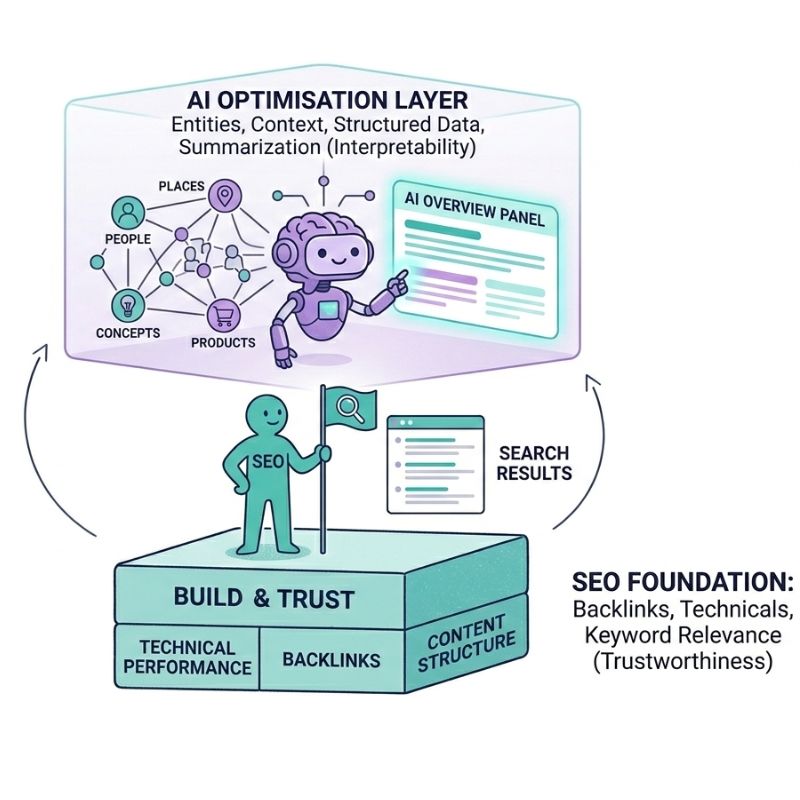
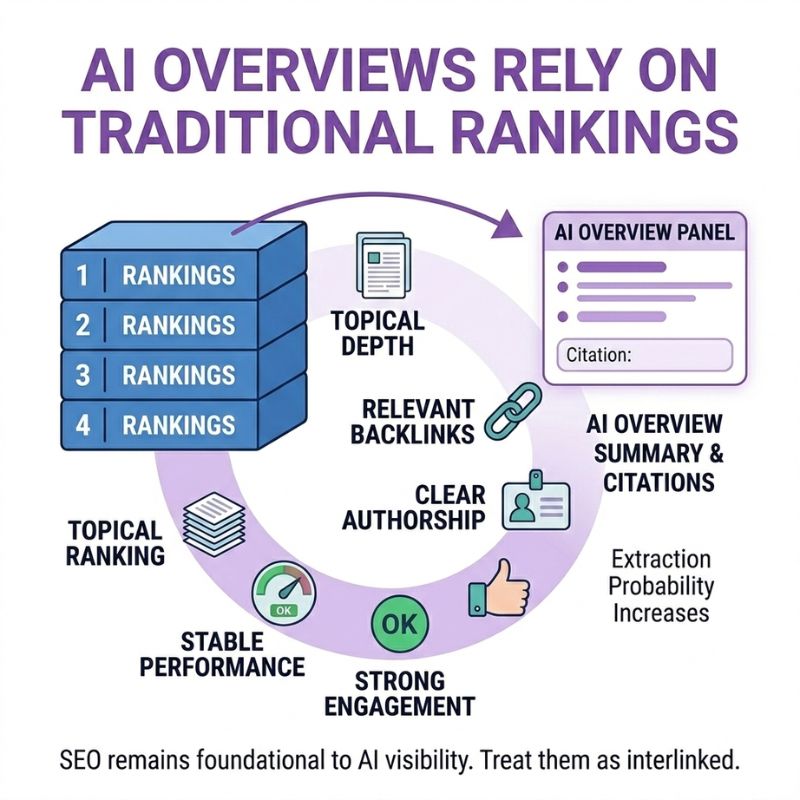
Mostly, no. Google’s own guidance on AI features is clear: “There are no additional requirements to appear in AI Overviews or AI Mode.” A page needs to be indexed and eligible to show in Google with a snippet, which is the same standard as normal search. That is why good SEO remains the foundation of AI visibility.
Where AI search does differ is in how answers are put together. A traditional search result sends people to one page. An AI answer pulls short passages from several sources and combines them. That rewards content that answers a question clearly in a sentence or two, and businesses that are described the same way across many trusted websites. You may hear this called GEO (generative engine optimisation) or AEO (answer engine optimisation). In practice, it is SEO with extra attention on clarity, consistency and reputation.
Step 1: Let Search and AI Crawlers Into Your Website
If a crawler cannot reach your pages, nothing else you do will help. Check your robots.txt file (yourdomain.co.uk/robots.txt) and make sure it does not block these:
- Googlebot, which feeds Google Search, AI Overviews and AI Mode.
- Bingbot, which feeds Bing and Microsoft Copilot.
- OAI-SearchBot, which OpenAI says it uses to show websites in ChatGPT search. OpenAI advises site owners to allow it if they want to appear.
- PerplexityBot, which Perplexity uses to find pages for its answers.
Some hosting firewalls and security services block AI crawlers by default, so it is a good idea to check those settings too. Blocking crawlers that collect data for AI training, such as GPTBot or Google-Extended, is a separate choice. It does not remove you from normal Google results.
Step 2: Make Sure Google and Bing Have Indexed Your Pages
AI tools lean on search engine indexes. Google’s AI features use Google’s index, and Microsoft Copilot uses Bing’s. Many small businesses set up Google Search Console and forget Bing completely, which leaves them out of the Microsoft side of AI search.
- Add your website to Google Search Console and submit your sitemap.
- Do the same in Bing Webmaster Tools. You can import your sites straight from Google Search Console.
- Check that your important pages are indexed, and fix any that are blocked, duplicated or marked noindex by mistake.
- Keep important information in normal text on the page, not only inside images, PDFs or pop-ups.
Step 3: Make It Obvious Who You Are and Where You Work
AI tools describe businesses as “entities”: a named business that offers specific services in specific places. The clearer and more consistent your details are, the more confident an AI tool can be when it recommends you.
- Use exactly the same business name, phone number and service area on your website, Google Business Profile, social profiles and directory listings.
- Give each main service its own page, and say plainly what it is, who it is for and where you offer it.
- Write an About page that explains who runs the business and what experience they have.
- Add schema markup (structured data) such as Organization or LocalBusiness, and make sure it matches what visitors can see on the page.
- Keep your Google Business Profile complete and up to date. Google’s guidance on AI features specifically mentions keeping business profile information current.
The clearer and more consistent your business details are, the more confident an AI tool can be when it recommends you.
For local businesses, this step carries a lot of weight. We explain how AI tools choose which local businesses to recommend in How AI Search Decides Which Sussex Businesses to Recommend.
Step 4: Write Answers That AI Can Quote
AI answers are built from short passages. A page that buries the answer in the fifth paragraph is far less likely to be used than one that answers the question straight away.
- Use the questions your customers ask as headings, for example “How much does a boiler service cost?”
- Answer each question in the first one or two sentences under the heading, then add detail.
- Make each section make sense on its own, so it still reads well if an AI tool lifts it out.
- Be specific. Prices, timescales, areas covered and steps in your process are more useful than general claims.
- Add what only you know: examples from your own work, the mistakes you see customers make, and the recommendations you give in person.
- Use lists and simple tables where they help. They are easy for people and machines to read.
A useful test is to read a section out of context. If it would still answer the question for a stranger, it is ready to be quoted.
Step 5: Build Your Reputation Beyond Your Own Website
AI tools rarely recommend a business on the strength of its own website alone. They look for confirmation from other sources, in the same way a customer would ask around before choosing.
- Ask happy customers for Google reviews, and reply to them.
- Get listed in respected directories and trade bodies for your industry.
- Look for mentions in local news, partner websites, podcasts and community organisations.
- Keep your social profiles active and consistent with your website.
Each mention from a trusted source adds weight. A business that is described the same way by its website, its reviews and independent sites is easy for an AI tool to trust.
Step 6: Cover Your Subject in Depth
One page about your main service is rarely enough. Websites that cover a subject thoroughly, with several related pages linked together, are easier for search engines and AI tools to understand. Build a main service page, support it with articles that answer the common questions around it, and link them to each other. Our local SEO services work follows the same approach for clients.
What Not to Waste Time On
There is a lot of noise about AI search. These are the things we see small businesses spending time and money on with little to show for it:
- llms.txt files. This is a proposed file for AI tools, but Google has said it does not endorse it, and its guidance says no special files are needed for AI features.
- Special “AI schema”. Google says no particular structured data is required to appear in AI Overviews or AI Mode. Standard schema that matches your page is enough.
- Mass-produced AI content. Dozens of near-identical pages written by an AI tool add little that is new. Search engines are increasingly good at spotting this, and it can drag down the rest of your site.
- Tools that promise guaranteed AI rankings. No one controls what an AI tool says. Anyone who guarantees a mention is guessing.
How to Check Whether You Appear in AI Search
AI visibility is harder to measure than rankings, but you can build a clear picture with free tools:
- Ask the AI tools yourself. Each month, ask ChatGPT, Copilot, Perplexity and Google the questions your customers would ask, such as “Who is a good accountant in Crawley?”. Note who is mentioned and which sources are cited.
- Google Search Console. Since June 2026, Search Console has had a Generative AI report under Performance. It shows how often your pages appear in AI Overviews and AI Mode, by page, country and date. It shows impressions but not clicks, and it only appears once your site has enough AI impressions. Clicks from AI features are counted in the normal Web performance report.
- Bing Webmaster Tools. The AI Performance report, launched in public preview in February 2026, shows how often your pages are cited as sources in Microsoft Copilot and Bing’s AI answers.
- Google Analytics 4. Check your referral traffic for visits from sources such as chatgpt.com, perplexity.ai and copilot.microsoft.com.
- Ask new customers. Add “How did you hear about us?” to your enquiry form. Some will tell you they found you through ChatGPT or Google’s AI.
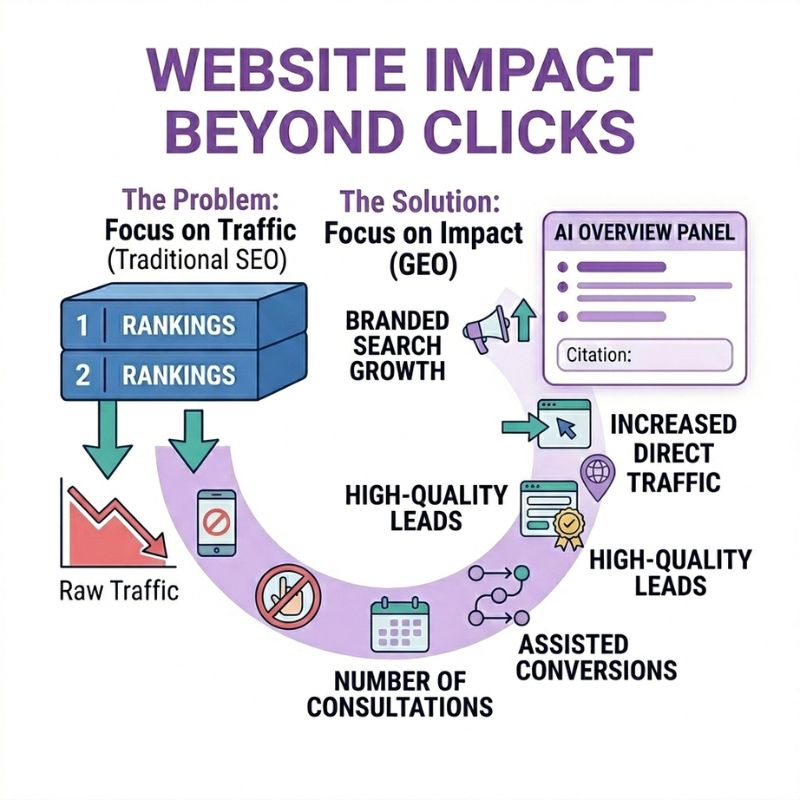
AI visibility often shows up as better enquiries and more people searching for your name, rather than a jump in website visits.
AI answers can reduce clicks because people get what they need without visiting a website. That makes enquiries, bookings and searches for your business name better measures of success than traffic alone.
Case Study: How We Built Our Own AI Search Visibility
When we set out to improve our own visibility in AI search, we treated it as an SEO project with extra attention on clarity. We restructured our content around a clear topic cluster: a main guide supported by articles on measurement, website structure and writing for AI. We standardised our heading structure, added schema markup consistently, linked related articles together and merged thin pages into stronger ones.
We also rewrote key sections so each one opened with a clear, standalone answer, and expanded our author information to show our experience in SEO and marketing. The result was a 14% rise in consultation enquiries. None of this needed special AI tools. It was careful, consistent work on the basics, which is exactly what we recommend to clients.
Using AI Tools to Write Your Content
AI writing tools can speed up research and first drafts, but they should never be the final word. They make factual mistakes, and they tend to produce the same general advice as everyone else. The parts of a page that AI search tools value most, such as your experience, your examples and your opinions, are the parts an AI writing tool cannot supply. Use it to help, then edit every page so it sounds like you and says something only you could say.
AI Search Optimisation Checklist
Work through this list one item at a time. Most of it is a one-off job, followed by small monthly habits.
Access and Indexing
- Googlebot, Bingbot, OAI-SearchBot and PerplexityBot are not blocked in robots.txt
- Your firewall or security service is not blocking search or AI crawlers
- Your website is verified in Google Search Console with a sitemap submitted
- Your website is verified in Bing Webmaster Tools with a sitemap submitted
- Your key pages are indexed and load quickly on mobile
Clarity and Consistency
- Your business name, phone number and service area are identical everywhere
- Each main service has its own clear page
- Your About page explains who you are and your experience
- Organization or LocalBusiness schema is in place and matches the page
- Your Google Business Profile is complete and up to date
Content
- Headings use the questions your customers ask
- Each answer appears in the first one or two sentences of its section
- Pages include specific details such as prices, areas and timescales
- Pages include your own examples and experience
- Related pages link to each other
Reputation
- You ask every happy customer for a Google review
- You are listed in the main directories and trade bodies for your industry
- You have mentions on local or industry websites
Measurement
- You check AI tools monthly with your customers’ questions
- You review the Generative AI report in Google Search Console
- You review the AI Performance report in Bing Webmaster Tools
- You track AI referral traffic in GA4
- Your enquiry form asks how people found you
Frequently Asked Questions
How Long Does It Take to Appear in AI Search?
It varies. Fixing access and indexing problems can make a difference within weeks, once crawlers revisit your pages. Building the reputation and depth of content that leads to regular AI recommendations usually takes several months of steady work.
Can I Pay to Appear in AI Answers?
Not in the answers themselves. ChatGPT now shows adverts in the UK on its free plans, but OpenAI says they are labelled as sponsored, kept separate from the answer and do not influence it. The sources an AI tool cites in its answer are chosen by the tool.
Do I Need a Separate Strategy for ChatGPT and Google?
No. The foundations are the same: crawlable pages, a clear business identity, useful answers and a good reputation. The main difference is making sure you are indexed by Bing as well as Google, and that you do not block OAI-SearchBot.
Does Schema Markup Help With AI Search?
It helps search engines understand your business, which supports AI visibility. It is not a requirement, and it only helps when it accurately matches what is on the page.
Get Help Appearing in AI Search
At Mouthy Marketing, we help small and medium-sized businesses get found in Google, Bing and AI search, and turn that visibility into enquiries. If you would like us to check how your business shows up in AI answers today, book a free call and we will talk you through what we find.

About the Author
Alice Watkyn has owned and run Mouthy Marketing, a marketing and SEO agency based in East Grinstead, since 2020. She believes in marketing done the right way. She has run campaigns for big and small brands, as well as national and international charities, but her passion is small business, and that is what she writes about.
She runs small business clinics, where she helps business owners with all kinds of marketing problems, from SEO to pricing. Many of her clients stay with her for years.